Pages

Showing posts with label stories from the ground. Show all posts

Friday, August 9, 2013

The Nile


By: John Jefferson
The Nile
Despite the many challenges they face, the people of Sudan, and I’m speaking of those who identify as Sub-Saharan Africans, have a spirit that refuses to yield to the forces that have tried to remove, enslave and kill them over the centuries.  Without fail one often finds moments when the pain, suffering, corruption, inhumanity, injustice and bitter striving vanishes and you are made to feel like you just stepped into eternity and are seeing things as God ordained them to be, not as Man has caused them turn out through his evil devices.  I had just such a moment on the Nile River returning from the Nuba Mountains.  Our Land Cruiser had just had a second tire blow out.  One which had it occurred a few hours earlier deep in the bush, would have landed us in big trouble.  As it happened, there was a military base not far from where we were so some of the team went to get help.  After waiting an hour or so, a couple of us, at my insistence, followed the trail of a few of the women we had seen passing by with containers to be filled with water.  We left the dry roadside as the sun was beginning to settle on the horizon and walked along the dusty trail.  As we approached the river, the ground yielded more plants and grasses giving way to a lush flora and an inviting breeze tinged with the smell and taste of algae and moisture as the oppressive heat began to vanish.

Behind us lay a dazzling sunset complete with beams of light shooting through the gathering cumulus clouds set against a bucolic backdrop of animal cries, rustic huts, and an exploding tapestry of color.  Before us lay the Nile, an ancient snake winding its way through mountains, grasslands, and heath. 

Immediately a calm came over me as we came upon two ladies who were ending their day fishing at the river’s edge.  One had just caught a small fish, and with a childish grin turned toward us as she spoke to her companion in a bubbly sounding dialect that seemed to bounce past my ears and over the ripples of the Nile itself.  They posed for a picture and shared the moment with us, one of peace beside the cool waters and amidst the lush green reeds and grasses of the sandy banks.  As the sun disappeared, they gathered their meager possessions; plastic buckets, ragged shawls, bamboo poles, and began to make their trek back to their mud huts.  You could see from their faces and the way they walked they had led hard lives, by our standards at least.  We know they have seen war, famine, disease, and experienced oppression of one sort or another.  Yet, in the moment we shared with them none of that was apparent.  It was like a cool drink of living water passing right through us, reviving our spirits after a long hot journey. 

One of our cell phones rang, the rest of the team that had busied themselves in finding a solution to the tire problem, had resolved it and were looking for us so we could continue our journey to Malakal before nightfall.  Fall it did, but we eventually wound up back at the shores of the Nile, although a different Nile.  The blackness that now enveloped us could not hide the fact that it was not the place of the two ladies fishing along the river’s edge, but the place of transport, commerce, and human industry on the outskirts of the northern most major city in the Republic of South Sudan.  As we moved across it I thought briefly of the two friends I made and the moment I shared with them.  Once again Sudan had challenged my belief that I could really understand or define her, and once again, she won.

Thursday, August 8, 2013

Got School?


By: John Jefferson
Got School?

Since the war broke out over a year and a half before we arrived, the hundreds of kids in the villages around where we served had not been in school.  Prior to that, I was told there were a couple of semi-literate female teachers that were sent from the North, but they only had the students recite the Koran.  In essence, many of the children have not received decent instruction in a long time, if ever.  More interesting still was the fact that there were a couple of teachers around, but they didn’t have chalk, pencils, paper or instruction manuals to teach the children.  They even had a school building, which we used to convene a session with some of the kids from the villages, whom I gave crayons and paper to so they could have an activity while we were there.  Upon our return to Malakal, we purchased the supplies and made arrangements to get lesson books so that classes could begin again.  The food is essential, but right behind it is the need to have the next generation prepared to lead the Nuba when the conflicts are over.  Without education they know they have little chance of success and more likelihood of remaining a marginalized and forgotten people.

Tuesday, August 6, 2013

Abandoned Villages


By: John Jefferson
Abandoned Villages


Anyone that has taken a family vacation in the West can recount memories of visiting old abandoned Indian villages.  Vestiges of the past, perhaps with a person there to show you what the people that lived there did to make clothing, prepare food, and even bury their dead.  With a little imagination, one could picture what it was like when these indigenous people roamed the plains freely and called these places home, despite how desolate and forsaken they look today.  Similarly, the Nuba Mountains holds villages emptied of their inhabitants, as if they were roadside attractions awaiting the queue from the tour operator to come alive in a demonstration of what had been.  The sad reality is that the villages being emptied symbolize the success of the eradication program taking place throughout the region.  In places like Bit Akel and El Feid, we saw well preserved homes, some missing their grass roofs, but otherwise intact.  Sometimes contents of the tukuls were strewn about as if the occupants left in great haste.  We saw bed frames, jerry cans, and shattered pots in one of them.  Looking at the empty villages one might assume they have been that way for years, but that is not the case.  They are artifacts of the war; bombings, raids, and military attacks on civilians caused them to leave and leave in a hurry.   When I first saw the “evidence” of what was happening in Darfur in the early 2000s my mind immediately told me that the scorched earth and smoldering mounds where a village was purported to have been was some fabrication.  I couldn’t immediately grasp that those scenes ever could have been of a place where generations of simple farmers and herders built compounds, grew crops, raised their children, worshipped their God, and died at a good old age.  I tried to convince myself the reason there was nothing there is because there never was anything there.  In 10 years of seeing how the Sudanese can transform a naked patch of earth into a place of vitality, tradition, and hospitality, I now know coming across the remains of what was a village is only a result of some tragic, horrible event, no less impactful than seeing devastation wrought by fire, flood or earthquake in the States.  In fact, it is more tragic and horrible in places like Nuba and Darfur because these are manmade, programmed and intentional acts of violence done on defenseless civilians eking out a living for generations.  Our hope, and theirs, is that they will be able to return to their homes soon, and not have them go the way of those Indian villages.

Monday, August 5, 2013

The Book


By: John Jefferson
The Book
Having brought 20 Arabic/English Bibles with me, it was my intention to share them with the local church.  Before even leaving, I found out that there was no local church, at least a highly identifiable one with a pastor, congregation and location to meet.  Even with a Muslim population somewhere north of 95%, these refugees (really IDPs) were without an Imam or functioning mosque, so it was understandable the Christian population wasn’t any better off in terms of support.  Also, out of respect for the situation we were in, I knew it would be tricky handing the Bibles out. (Sudan, like many “Muslim” nations, is technically closed to evangelism or just sharing Christianity, and many have died because of their faith as well as their tribal, political, racial and other affiliations)   The long story short, we weren’t there to stir the pot any more!  That said, we did pray for opportunities to share both the Bibles and the reason why we would risk our lives to help people who could in no way return the favor.  That is in itself a Gospel message of course.

One particular case struck me as something only God could have orchestrated.  On my first day in the compound in Kau, one of the military leaders was speaking through an interpreter, and asked for a Bible.  Because I had just given the highest ranking officer one and didn’t want to start an avalanche of giving out Bibles as honorariums to officials, I brushed off the request.  At the time I thought they would be hot commodities just because they looked kind of cool (black leather-like cover with fancy Arabic script on the front in gold letters).  In a place with no books, newspapers or magazines, it’s easy for something like a Bible to become a quick status symbol and rob people who want what’s inside of it from having the opportunity.  It was early in the trip and I was being conservative about doling them out for that reason.  Along the way, I found it difficult to hand them out because it was never in a context where people weren’t around watching, which always leads to more requests than can possibly be filled.  Not having a local clergy person to funnel them through and being busied with the work of food distribution and recording the events, left only sporadic, hastened moments where I could discover someone was a Christian or interested in the Bibles, locate them in the midst of everything else that was inevitably going on at the time, then determine if this was the right person and context in which to hand the Bible out.  Sounds like I’m overcomplicating it to some I’m sure, but unless one’s ever been in a closed country during what is, in part, a religious war, it’s hard to give a sense of both the physical and spiritual resistance that comes along with even the simplest acts of sharing one’s faith.

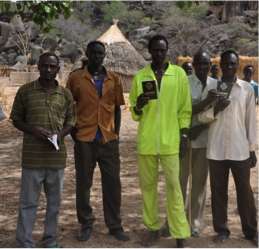
Despite the obstacles, after handing out most of the Bibles, one to a man in Warni, who requested it, another to the school teachers in Kau that had no books and requested all I could give them, and some to individuals at the compound we stayed in that identified themselves as Christians, I had only a few left by our last full day in the region.  It happened that as we were leaving Niaro for the last time, a man in a bright, almost fluorescent yellow running suit came up to the passenger side window of the vehicle in which I was riding and started talking to me and the men inside.  I had made the mistake of not having the books handy in prior cases where someone came up to me at the last minute before leaving.  This time I was prepared and had a couple of Bibles.  I asked if he was a Christian and the man replied, “yes”.  I gave one to him and a couple out to some of the guys that were with him, who also asked for one.  Then, someone in the car said, “This is the man who asked for a Bible earlier in when we were in the compound”.  I thought, wow, I kind of blew him off then, and now here I am handing him one in a completely different setting a couple of days later without even realizing it!  It was a very cool moment which I had to capture on my camera and will remember forever.  I felt bad about some of the earlier interactions I had where I withheld just handing a Bible out because I was worried about my supply.  I should have realized that though it is always good to be circumspect when giving things away in a place such as this, it’s also good to give freely though with discernment.  In this case, I felt like God was looking out for me and making sure the Bibles got in the right hands no matter who was “in charge” of giving them out.

Friday, August 2, 2013

Warni – Somewhere in the Middle of Nowhere


By: John Jefferson
Warni – Somewhere in the Middle of Nowhere
We first heard about this obscure village in the middle of the southern mountains of South Kordofan over a year ago when the End Nuba Genocide group was asked to reroute a planned mission to the area north of Yida refugee camp.  Given the time, logistics and resources available to our small and nimble, but very constrained team, it was impossible to pivot.  The idea of helping these people in one of the most remote portions of the Nuba Mountains never left my mind and with the concurrence of the team, we decided the next trip would be focused on these neediest of victims of Bashir’s plan of eradication and removal.


As we drove to Warni from Kau, two things became very apparent.  The first was that no one was living on the rich fertile plains between the two mountainous areas, at least not recently.   There were abandoned villages along the road, but the fields lay fallow and except for the rare troop movement, there was no traffic.  We didn’t even see herds of goats or cattle.  The land was desolate.  I was quickly informed that this was due to the triple threat of bombing raids, militias and marauding cattle and goat herders that had terrorized the people before the war and intensified their activities since its inception.  Despite the fact that the SPLA-N had been able to rid the area of enemies, the people were now sequestered in the garrison towns for their own protection.  Thus, when we arrived at the “small” village, we were greeted by throngs of people anticipating the first food distribution.

After meeting with the local commander, we went out to observe the food distribution.  Several sacks of sorghum that were purchased in Malakal were on hand and as the people started queuing up, it was evident that demand far exceeded the supply we had.  There were hundreds of kids and women coming out of seemingly nowhere (many of the homes are in the rocks and trees, not too many compounds lie outside the foothills of the mountains for security reasons).  Hundreds of scoops of grain were put in every kind of bag, dish, and receptacle one could imagine until about 1,000 lbs were distributed.  I realized how important it was to have exceeded our own expectations of what we could make available by joining with the Nuba relief organization, NRRDO.  Together we were able to procure 46 tons of food, which will be sorely needed in Warni and Kau-Niaro in the weeks to come.

One thing was apparent about these people that have been subsisting on weeds, roots, and insects for I don’t know how many months:  They are incredibly strong and resilient.  No one was close to over weight (except me), but everyone except the oldest and youngest appeared remarkably strong.  Even those frighteningly thin.  I realized that weakness is not an option in a place where the sun mercilessly beats down all day, the threat of death from opportunistic disease or hunger looms constantly, and at any time planes could fly overhead and deliver a lethal dose of cluster bombs without concern for the fact that they are being aimed at civilian targets.  Beyond that, I saw a will to survive and overcome these adversities in each and every one of the Nuba people.  I could see it in their eyes and hear it in their voices as I interviewed one after another about what was happening to them and asked what they would like to tell the world.  Stories about the bombings, lack of food, desire for peace, and questions as to why the outside world seems to have forgotten them, were shared with me over and over.   All I could do was nod in sympathy and tell them there were many who cared and were praying for them.  I also let them know that we were going to try and be their voice when we returned with the pictures and videos depicting their plight.  I saw disappointment and even despair in some of them, but I never saw what I’d call a broken people.